How to Tell If a Tree Is Dangerous
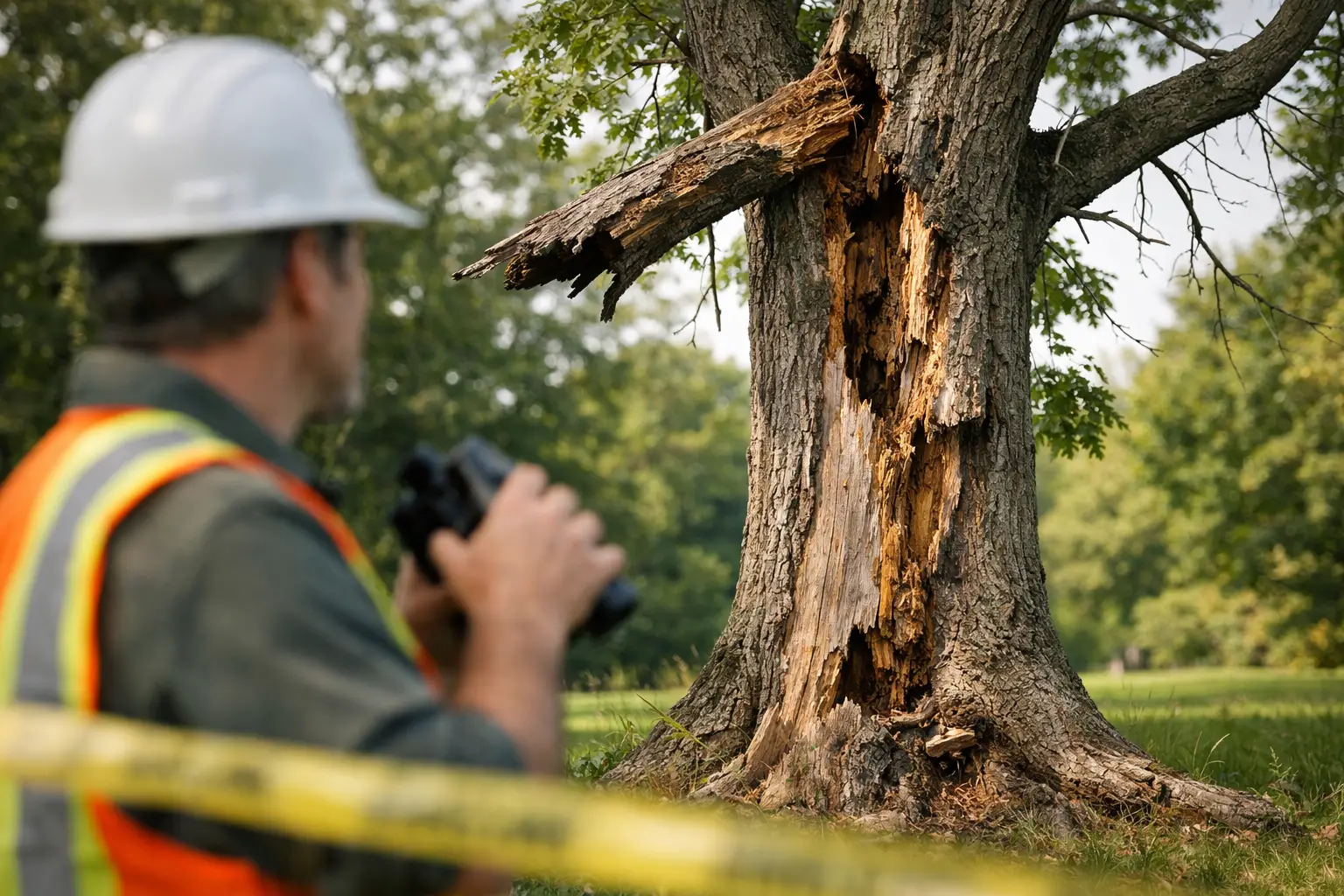
That big tree in your yard usually fades into the background until a limb starts hanging over the roof, the trunk develops a crack, or a storm rolls through Austin and suddenly the whole thing feels a lot less charming. If you're wondering how to tell if a tree is dangerous, the goal is not to become an arborist overnight. It is to spot the warning signs early enough to protect your home, your family, and the cars, fences, and power lines around it.
Some tree problems are obvious. A trunk split after a storm is hard to miss. Others are quieter and more common - slow lean changes, dead upper limbs, hollow sections, root damage, or branches rubbing over the roofline. A dangerous tree is not always a dead tree, and a healthy-looking tree can still fail if the structure is weak or the roots are compromised.
How to tell if a tree is dangerous near your home
Start with the question that matters most: if this tree or limb falls, what could it hit? A tree in the back corner of a large lot carries a different level of risk than a tree hanging over a bedroom, driveway, fence, or service line. The same defect can be manageable in one spot and urgent in another.
That is why homeowners should look at both condition and target. A limb with decay over open lawn may be less urgent than a smaller cracked limb directly above your roof. Risk is about the tree's condition, the chance of failure, and what sits underneath it.
Leaning that is new or getting worse
Not every leaning tree is dangerous. Some trees grow with a natural lean and stay stable for years. The problem is a lean that appears suddenly or increases over time, especially after heavy rain or wind.
Watch the soil around the base. If the ground looks lifted on one side, cracked, or heaving, that can point to root plate movement. In plain English, the tree may be starting to pull out of the ground. That is a serious warning sign and usually needs prompt professional attention.
Cracks, splits, and weak branch unions
A visible crack in the trunk or a major limb is one of the clearest signs of structural trouble. Some cracks are shallow bark damage. Others run deep into the wood and reduce the tree's ability to hold itself together under load.
Also pay attention to where large stems meet. If two trunks form a tight V-shape with bark pinched between them, that union is often weaker than it looks. In wind or storms, those stems can split apart. This is especially risky when one of those leads extends over a house, garage, or street.
Dead limbs in the canopy
Dead wood is not just an appearance issue. Large dead limbs can drop without much warning, even on a calm day. Smaller dead branches may be minor, but larger ones over roofs, walkways, patios, or play areas deserve attention.
A dead limb often has no leaves during the growing season, brittle twigs, peeling bark, or obvious decay where it attaches to the parent branch. In mature trees, dead wood in the upper canopy is common, but that does not mean it is safe to ignore.
Signs of decay that should not be brushed off
Decay is where a lot of homeowners get caught off guard. A tree can still have green leaves and live tissue while carrying significant internal rot. That means you cannot judge safety by foliage alone.
Look for cavities, hollow spots, mushrooms or fungal growth near the trunk flare, and areas where bark is missing with soft or crumbly wood underneath. If you can easily push into the wood with a screwdriver, the tree may have more decay than you can see from the outside.
Hollow trunks and cavities
A hollow tree is not automatically doomed. Some trees compartmentalize decay and keep enough strong outer wood to remain standing for years. But the size and location of the hollow matter a lot.
If a cavity is large, near the base, or paired with cracks or a heavy lean, the risk goes up fast. A hollow section in the main trunk is far more concerning than a small cavity in a non-structural area.
Fungus at the base
Shelf fungi, mushrooms, or conks growing from the trunk or root flare often suggest internal decay. That does not always mean immediate failure, but it is not something to ignore either. Fungal fruiting bodies are basically evidence that decay organisms are active inside the wood.
For Austin homeowners, this gets more important after drought stress followed by rain. Trees weakened by repeated environmental stress can look fine one month and decline quickly the next.
Root problems are easy to miss and expensive to ignore
Roots hold the whole system in place, and root failure is one of the most dangerous tree issues because there may be little warning before the tree goes over. Most of the important roots are in the upper soil, where construction, trenching, grade changes, and repeated compaction can do damage.
If you recently added a driveway, patio, pool, irrigation line, or foundation work near a mature tree, pay attention. Cutting roots or piling soil over them can destabilize the tree over time.
Other red flags include exposed roots that look broken, mushrooms near the base, sudden canopy thinning, and soil movement around the trunk. If a tree starts leaning after root disturbance, that is not a wait-and-see situation.
Storm damage and hidden hazards
After a storm, the most obvious problem is not always the most dangerous one. A branch that already fell is visible. The branch that cracked but stayed hung up in the canopy is often the bigger immediate threat.
If you see hanging limbs, twisted branches, fresh splits, or a canopy that now looks uneven, keep your distance. Do not stand under it to inspect it. Do not try to pull it down with a rope. Tensioned limbs can release unpredictably, and partially failed branches can swing or drop with more force than people expect.
This is also where power lines change the whole situation. If any limb is touching or near a line, treat the area as hazardous and stay clear. Tree work around energized lines is not a homeowner project.
When trimming can fix the problem and when removal makes more sense
Not every dangerous-looking tree has to come down. Sometimes the issue is isolated deadwood, an overextended limb, poor roof clearance, or a canopy that needs weight reduction and proper pruning. Good pruning can reduce risk, improve clearance, and help the tree hold up better in storms.
But there are limits. If the trunk is badly decayed, the roots are failing, the tree is splitting, or the lean is active, trimming may not solve the underlying problem. In those cases, removal is often the safer call, especially in tight residential spaces where failure could hit a home, fence, or neighboring yard.
The hard part is that homeowners often get mixed advice. One crew says everything should be cut down. Another says it is fine. Straight answers come from looking at the specific defect, the location, and the likely target if something fails. There is no honest one-size-fits-all rule.
When to stop inspecting and call a professional
If the tree has a fresh lean, trunk crack, hanging limb, root movement, major deadwood over a structure, or any involvement with power lines, it is time to stop poking around and get it assessed. The same goes for large oak limbs over roofs, because a lot of damage happens before people realize how much weight those branches carry.
A professional assessment is not just about deciding whether the tree stays or goes. It is also about how the work would be done safely. In residential neighborhoods around Austin, that often means controlled rigging, careful cuts, and planning around roofs, fences, driveways, and nearby landscaping.
For homeowners who want a practical rule, use this one: if you would be worried about your family standing under it during the next storm, do not wait too long to have it looked at. Douglas Tree Service ATX sees that pattern often - a tree that seemed fine until one windy night made the decision for the homeowner.
A quick way to check your yard seasonally
You do not need a complicated checklist. Walk the property a few times a year and after major storms. Look up into the canopy, then back down at the trunk flare and surrounding soil. Notice anything new - dead limbs, bark loss, cracks, soil lifting, fungi, or branches extending too close to the house.
The key is change. A tree that has looked the same for ten years is different from one that suddenly looks thinner, leans more, or sheds large limbs. Trees usually give some warning. The problem is that people get used to seeing them and stop noticing what has changed.
If something feels off, trust that instinct and have it checked before it turns into an emergency. A quick visit and a straight answer are usually a lot cheaper than a roof repair, a crushed fence, or a middle-of-the-night storm call.
Texas Tree Authority Hub
Official Texas resources we trust.