How to Handle a Leaning Tree Safely
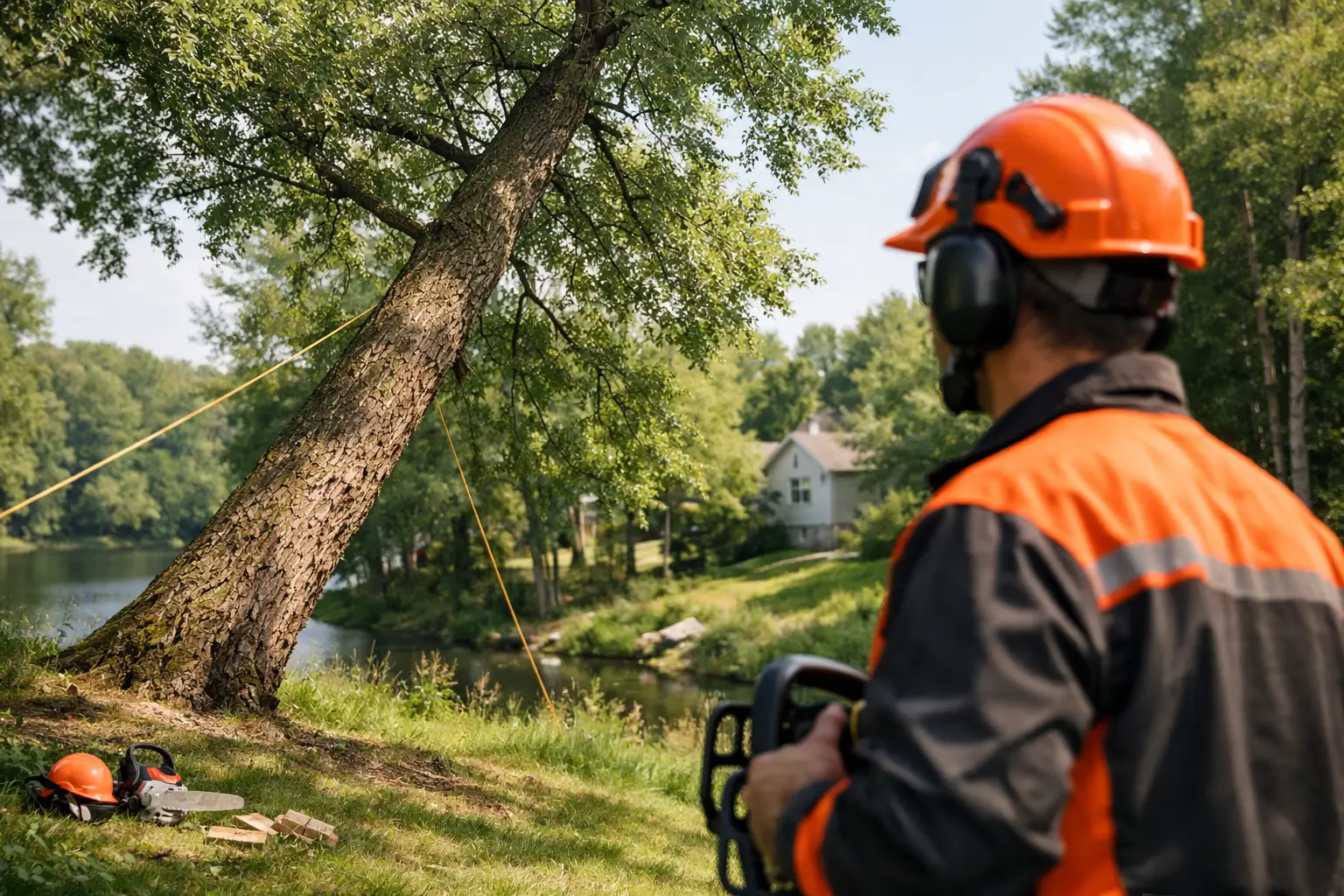
A tree that suddenly starts leaning after a storm gets your attention fast. So does a tree that has been creeping farther off-center year after year, especially if it points toward your roof, fence, driveway, or power line. If you are wondering how to handle leaning tree problems on your property, the first step is simple - do not guess, and do not treat every lean the same.
Some trees naturally grow at an angle and stay stable for decades. Others are one hard rain away from tearing up the root plate and coming down. The difference usually shows up in the ground, the trunk, and the canopy. A homeowner does not need to diagnose every structural issue, but you do need to know what deserves immediate action and what can wait for a scheduled inspection and quote.
How to handle a leaning tree without making it worse
The biggest mistake homeowners make is trying to "straighten" a mature leaning tree on their own. Once a tree has established a lean, the trunk, roots, and crown have already adjusted to that load. Pulling on it with a truck, adding random straps, or cutting roots to make mowing easier can turn a manageable issue into a failure.
What you can do right away is reduce risk around the tree. Keep people, pets, and vehicles out of the fall zone if the lean looks recent or severe. Avoid parking beneath it. If a large limb is hanging over the house or the tree is leaning toward a high-value target, treat it as urgent.
You should also look at the base from a safe distance. Fresh soil lifting on one side, cracking ground, exposed roots, or a root plate that looks like it is pulling out of the earth are all bad signs. Those symptoms matter more than the angle by itself. A tree with a moderate lean and solid root support may be less dangerous than a tree with a slight new lean and failing roots.
When a leaning tree is normal and when it is dangerous
Not every leaning tree is a hazard. In residential yards, some trees grow toward sunlight, away from competition, or around nearby structures. A lean that developed slowly over many years, with a full healthy canopy and no signs of root movement, may simply be part of that tree's natural form.
The concern goes up when the lean is new, increasing, or paired with visible stress. Cracks in the trunk, splitting at a major limb union, hollow areas, dead sections in the canopy, mushrooms near the base, or peeling bark around a damaged root flare all point to reduced stability. Saturated soil can make things worse, which is why trees often fail a day or two after heavy rain instead of during the storm itself.
There is also a big difference between a young tree and a mature one. A small tree that has recently leaned can sometimes be corrected with staking if the root damage is minor and the tree is still establishing. A mature tree is a different situation. At that point, support systems, pruning, or removal may be safer than trying to force it upright.
Signs you should treat as urgent
If the tree has suddenly shifted, if the ground is heaving at the base, or if major limbs are already cracking, do not wait it out. The same goes for a tree leaning toward a home, garage, play area, pool, fence line, or service drop. Trees near structures need controlled work, not trial-and-error cutting.
In tight residential spaces, the job is usually less about whether a tree can be cut and more about how it can be removed without hitting what is nearby. That is where rigging, drop-zone planning, and property protection matter.
What homeowners should do first
Start by documenting what you see. Take a few clear photos of the full tree, the base, and any visible cracks or lifted soil. That helps if the lean changes and gives a tree crew a clearer picture before they arrive.
Next, stop any DIY trimming around the lean. Homeowners often think removing a few limbs will lighten the load, but cutting the wrong side can change the tree's balance in a bad way. Topping is especially risky. It creates weak regrowth, increases stress, and does not fix structural instability.
If branches are touching the roof or scraping in the wind, resist the urge to get on a ladder with a saw. Leaning trees store tension and compression in ways that are hard to read from the ground. One cut in the wrong place can make a limb swing, split, or drop without warning.
Repair, prune, brace, or remove?
This is where the honest answer is: it depends. The right fix comes down to the tree's age, species, lean history, target area, root condition, and structural defects.
A young tree with a minor lean may respond to corrective pruning and temporary staking. The goal is not to force it perfectly straight, but to help it reestablish while roots recover. That only works when the tree is still small enough to adapt and the lean is caught early.
A mature tree with a stable but awkward lean may only need selective weight reduction in the canopy. Done properly, that can lower end weight on long lateral limbs and reduce stress without over-thinning the tree. The trade-off is that pruning can improve risk, but it does not erase root or trunk defects.
In some cases, cabling or bracing can add support between major stems. That is not a cure-all, and it is not the right answer for every leaning tree. Support hardware helps in specific structural situations, but it will not save a tree with failing roots or severe decay at the base.
Then there are trees that should come down. If the lean is recent, the root plate is lifting, the trunk is compromised, or the target area below is too valuable to gamble with, removal is often the safest call. For homeowners, that can be hard to hear, especially with a large shade tree. But waiting usually does not make a failing tree cheaper or safer.
How to handle leaning tree issues after storms
Storm-related leans deserve extra caution because the damage is often hidden. A tree can look mostly intact up top while the root system has already shifted below grade. If wind pushed the tree and the soil is still wet, the next gust may finish the job.
After a storm, keep your distance and scan for secondary hazards. Look for hung limbs, split tops, torn bark, and anything touching utility lines. If the tree is involved with a power line, stay clear and let the utility company handle that part first.
Once the site is safe, the next step is getting a clear plan. Sometimes that means emergency removal. Other times it means removing one hazardous lead, reducing weight, and keeping the rest of the tree. The right crews will give you straight answers instead of pushing the same solution every time.
Why leaning trees go wrong during DIY removal
A lot of tree work looks easy from the ground. It rarely is. Leaning trees are unpredictable because the trunk and limbs are already under uneven pressure. Cuts do not always open or close the way people expect, and the tree may not fall where the lean suggests.
That gets more complicated near houses, fences, sheds, pools, and driveways. In residential neighborhoods, there is often no clean drop zone. Pieces have to be rigged down in sections, not just cut and hoped for. Insured crews with the right equipment are not just paying for speed - they are reducing the chance of property damage and injury.
For homeowners who care about curb appeal and safety, cleanup matters too. A tree job is not done when the trunk hits the ground. Brush, logs, sawdust, and ruts in the yard all affect how the property looks and functions afterward.
A practical rule for deciding your next step
If the tree has leaned for years and shows no signs of root movement, cracking, or decline, you likely have time to address it thoughtfully. If the lean is new, worsening, or aimed at something you cannot afford to lose, treat it like a priority.
A good tree company will not play guessing games with your property. They will look at access, nearby structures, the condition of the base, and whether the tree can be reduced safely or needs to be removed in controlled sections. That is the kind of no-pressure, straight-answer approach homeowners deserve.
At Douglas Tree Service ATX, the jobs that go best are usually the ones caught early - before a leaning tree turns into a broken fence, a damaged roof, or an emergency call in the middle of the night. If a tree on your property does not look right, trust that instinct and deal with it before the next storm makes the decision for you.
Texas Tree Authority Hub
Official Texas resources we trust.