Can Tree Roots Damage Driveway?
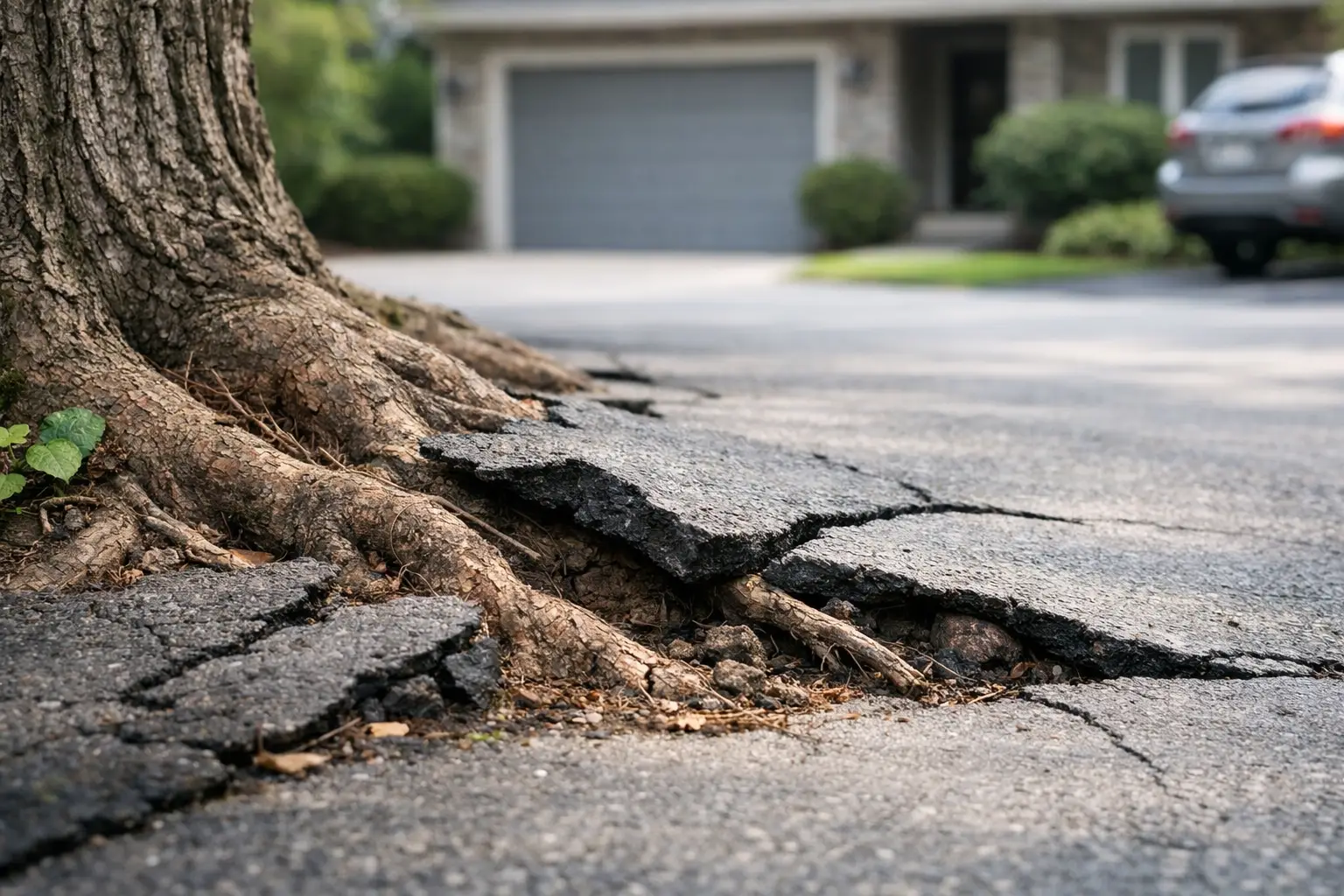
A driveway starts to tell on a tree before most homeowners notice the tree itself. One slab sits a little higher than the next. A hairline crack widens after a hot summer. Water starts pooling where it used to drain cleanly. If you are asking can tree roots damage driveway surfaces, the short answer is yes - but the full answer depends on the tree, the soil, the age of the driveway, and how close everything is built.
In a lot of yards, roots do not punch through concrete like a cartoon. What usually happens is slower and less dramatic. Roots expand as they grow, they follow moisture, and they take advantage of weak points that are already there. Over time, that pressure can lift sections of concrete, shift pavers, crack asphalt, and create trip hazards or drainage problems that get more expensive the longer they sit.
Can tree roots damage driveway concrete and asphalt?
Yes, both concrete and asphalt can be affected, but they fail in different ways.
Concrete is rigid. When a root grows under one section, the slab may lift, tilt, or crack because the material does not flex much. That is why homeowners often notice uneven panels or sharp vertical offsets in concrete driveways and sidewalks.
Asphalt has more give, especially when it is newer or installed in thinner layers. Instead of a clean break, you may first see rippling, soft heaving, or long surface cracks. In Texas heat, asphalt can become even more vulnerable because high temperatures make it easier for pressure from below to show through.
Pavers behave differently too. They may not crack right away, but they can shift, spread apart, or become uneven as roots disturb the base beneath them. In some cases, the pavers survive and the real damage is under the surface.
Why roots damage some driveways and leave others alone
The biggest mistake is assuming every large tree will wreck a driveway. Some do. Some do not. The difference usually comes down to a few practical factors.
Distance matters a lot. A mature tree planted too close to the driveway has less room to spread out, so roots are more likely to grow under hardscape. Species matters too. Some trees produce aggressive surface roots, while others tend to root deeper if soil conditions allow it.
Soil plays a role that homeowners often overlook. In parts of Central Texas, clay soils expand and contract as moisture changes. That movement can already put stress on a driveway. Add root growth underneath, and small issues become bigger faster. On the other hand, compacted or shallow soil can push roots closer to the surface, where they are more likely to interfere with concrete or asphalt.
Construction quality also matters. A driveway with a thin base, poor compaction, or existing cracks is easier for roots to disturb than one built with proper support. Sometimes the tree gets blamed for damage that started with a weak install.
Signs the driveway problem is root-related
Not every crack means a root is the cause. Driveways crack from age, moisture changes, vehicle weight, and soil settlement too. But a few signs make root pressure more likely.
If one section of the driveway is rising while nearby slabs stay flat, roots may be pushing from below. If the damage lines up with a large tree nearby, especially one with visible surface roots in the lawn, that is another clue. You may also notice a bulge that seems to progress over time rather than appearing all at once.
A good field check is to look at the pattern. Settlement usually creates sinking or low spots. Root damage more often creates lifting. That distinction is not perfect, but it helps.
Which trees are more likely to cause trouble
Fast-growing shade trees are often the ones that create driveway issues, especially if they were planted for quick coverage without enough space to mature. Live oaks, red oaks, elms, hackberries, and some maples can all cause problems when planted too close to pavement. Even smaller ornamentals can interfere with a narrow driveway if the root flare is already crowding the edge.
That said, species alone does not decide the outcome. A well-placed tree with room to grow may coexist with a driveway for decades. A poorly placed tree in a tight strip between the house and pavement is a different story.
What not to do when roots are lifting a driveway
The riskiest move is cutting roots without understanding what those roots are doing for the tree. A root that is causing pavement damage may also be providing major structural support or supplying a significant share of water to the canopy. Cutting the wrong roots can make a tree unstable, decline over time, or fail during a storm.
That risk goes up with mature trees close to homes, garages, fences, or parked vehicles. Homeowners sometimes assume they can trench along the driveway edge, cut a few roots, and solve the problem. In reality, they may trade driveway damage for a hazardous tree.
Another bad move is waiting too long. Once lifting gets severe, the fix is rarely small. Trip hazards worsen, water starts moving in the wrong direction, and repairs become more complicated because both the hardscape and the tree have to be considered together.
The real options when tree roots damage a driveway
When homeowners ask what to do next, the answer is usually one of three paths: modify the driveway, manage the roots carefully, or remove the tree. Which one makes sense depends on the extent of damage and the value of the tree.
If the tree is healthy, well-placed overall, and the damage is limited, driveway repair may be the better route. That could mean replacing a section, adjusting grade, or rebuilding with more room around the root zone. In some cases, rerouting a walkway or widening a planting bed makes more sense than fighting a mature root system.
If the roots can be pruned without creating a safety issue, selective root cutting may help - but only in the right situation. This is not a blanket fix, and it needs to be approached carefully. Cutting roots near a mature tree can affect stability, especially in wet weather or high winds.
If the tree is already in decline, too close to structures, or likely to keep causing expensive damage, removal may be the most practical long-term decision. That is especially true when the driveway damage is severe and the roots involved are large enough that repeated repairs will not hold.
Can you repair the driveway without removing the tree?
Sometimes yes. Sometimes no.
If the driveway issue is minor and the roots are not massive, a repair contractor may be able to grind offsets, replace one section, or rebuild around existing root growth. Flexible paving systems or redesigned edges can sometimes buy time.
But if large structural roots are directly under the slab, the problem usually returns. Concrete does not negotiate with a growing root. If the tree stays and continues expanding in the same footprint, repairs may only be temporary.
That is where honest property advice matters. Homeowners deserve straight answers about whether they are paying for a real fix or just resetting the clock for another couple of years.
When removal becomes the safer call
A tree does not have to be dead to be the wrong tree in the wrong spot. If a large tree is crowding the driveway, pushing toward the foundation, dropping heavy limbs over parked cars, and causing recurring pavement damage, keeping it may not be the best investment.
In tight residential spaces, removal also needs to be done with care. Trees over driveways are often close to roofs, fences, power lines, or neighboring property. This is not the kind of work where homeowners want a cheap crew guessing with gravity. Controlled dismantling, proper rigging, and full cleanup matter because the goal is to solve one property problem without creating another.
That is the kind of situation Douglas Tree Service ATX handles for homeowners who need safe tree work around driveways, homes, and other tight spaces.
How to reduce the odds of future root damage
If you are planning a new driveway or replacing an old one, the best protection starts before the pour. Give large trees enough distance. Match tree size to available space. Build the driveway with a proper base and compaction so it is not already vulnerable. In some layouts, changing the driveway shape by even a small amount can preserve both the pavement and the tree.
For existing yards, keep an eye on early signs. Small offsets and fresh cracks are easier to address than major lifting. If you are planting new trees, think about mature size instead of nursery size. A young tree always looks harmless next to a wide driveway. Ten years later, that same choice can be expensive.
The best time to deal with a root problem is when it still looks minor. Once concrete starts lifting, the tree is already telling you it needs more room than the site gave it.
Texas Tree Authority Hub
Official Texas resources we trust.