Best Time to Prune Oak Trees in Texas
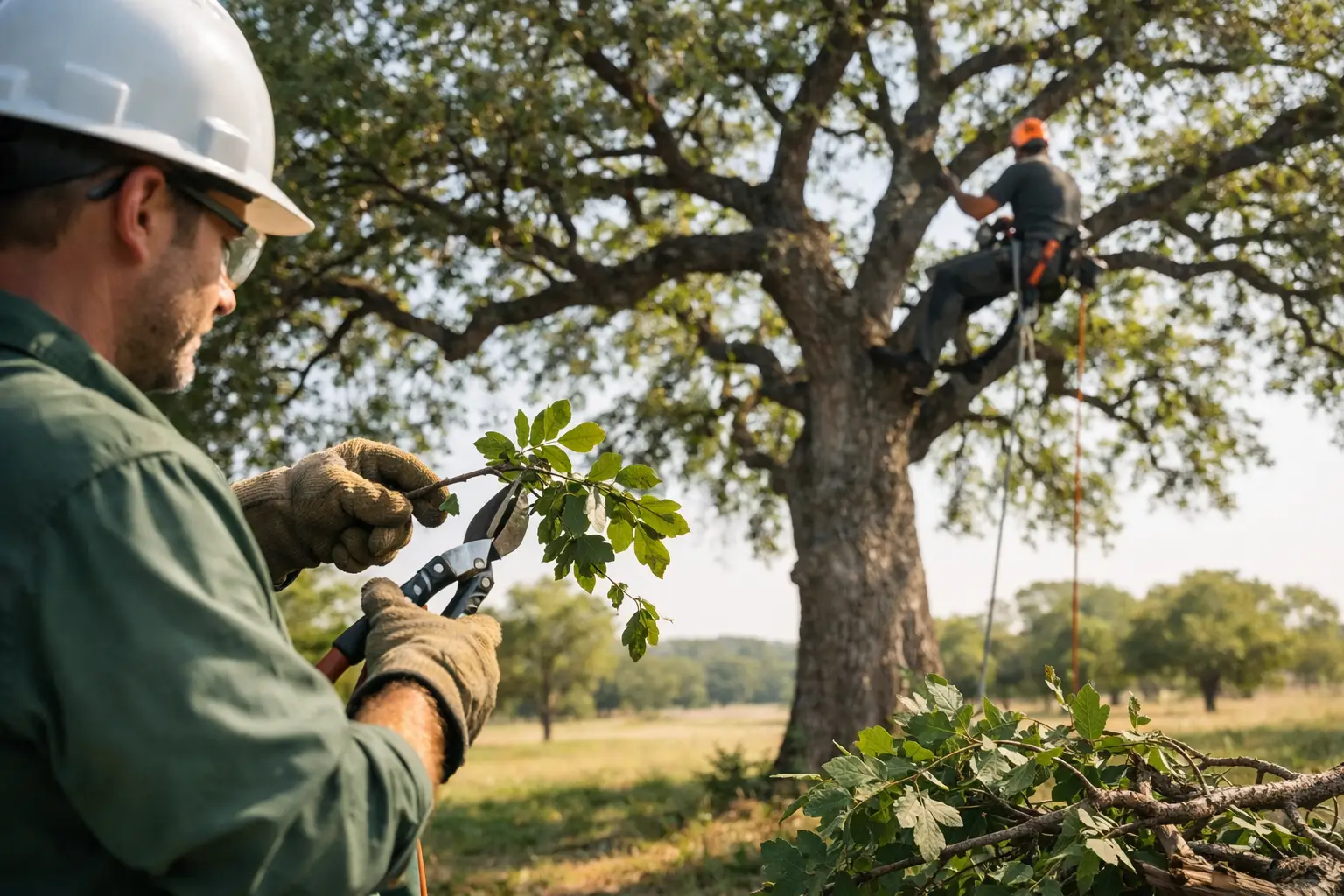
If you have an oak hanging over your roof or dropping limbs near the driveway, timing matters more than most homeowners realize. The best time to prune oak trees is usually during the coldest part of the year, when disease pressure is lowest and the tree is less likely to be stressed by the cut.
In Austin, that window is not just a nice-to-have. It is one of the biggest factors in reducing the risk of oak wilt, a fast-moving disease that has damaged and killed countless oaks across Central Texas. A clean cut made at the wrong time can attract beetles that spread the fungus, which is why oak pruning should never be treated like routine yard work.
Best Time to Prune Oak Trees in Austin
For most homeowners in Austin and nearby areas, the safest time to prune oaks is late fall through winter, with the ideal window generally running from November through January. That is when the insects most associated with spreading oak wilt are less active, and trees are in a better position to handle pruning.
February can still be acceptable in some cases, but this is where things start to depend on weather, species, and how much needs to be removed. Once temperatures begin warming up consistently, the margin for error gets smaller. Spring is the risky season, especially from February through June, when fresh pruning wounds are more likely to attract sap-feeding beetles.
That does not mean every oak cut made outside winter automatically causes disease. It means the risk goes up, and that risk is serious enough that most responsible tree professionals around Austin plan oak pruning around the dormant season whenever possible.
Why timing matters so much for oak trees
Oak trees are not unusually fragile, but they are unusually vulnerable to oak wilt in this part of Texas. The disease spreads through infected root systems and by beetles that are drawn to fresh wounds on certain trees. When pruning is done during high-risk periods, a wound can become an entry point.
That is why homeowners often hear a simple rule: prune oaks in winter and avoid pruning in spring. It is a good rule because it is easy to remember, but the real point is disease prevention. The goal is not just shaping the tree. The goal is protecting a mature, valuable part of your property from a problem that can be expensive and sometimes impossible to reverse.
Timing also affects stress. A heavy trim during extreme summer heat can push a tree that is already dealing with drought, compacted soil, and harsh sun. In Central Texas, many oaks are growing in tough conditions even on well-kept residential lots. Smart pruning works with the tree’s seasonal cycle instead of against it.
When you should avoid pruning oak trees
The main period to avoid is spring into early summer. In Austin, that usually means February through June is the highest-risk stretch for nonessential pruning. If the work can wait, it should wait.
Summer is a mixed bag. Emergency removal of a broken limb is one thing. Cosmetic thinning or reshaping is another. If a branch is rubbing the roof, cracked from wind, or hanging over a play area, safety comes first. But if the tree just looks a little overgrown, it is usually smarter to schedule the work for the winter pruning window.
Early fall can also require judgment. Conditions may be calmer than spring, but that does not make it the best time by default. For oaks, winter remains the safer standard.
What counts as emergency pruning
Sometimes waiting is not realistic. If a limb splits after a storm, starts resting on the roof, blocks access to the driveway, or threatens a fence, pool, or power line, the hazard needs to be addressed. In those cases, the issue is no longer seasonal maintenance. It is risk reduction.
Emergency oak pruning outside the ideal season should still be done carefully. Cuts need to be clean, limited to what is necessary, and handled with an understanding of how to reduce disease risk afterward. This is one reason homeowners are wise to avoid hiring whoever answers the phone first after a storm. Bad cuts, torn bark, and rushed work can create bigger problems than the original damage.
How much pruning is too much
Even during the best time to prune oak trees, timing does not make every cut a good one. Over-pruning can stress the tree, reduce shade, expose major limbs to sunscald, and create weak regrowth. Topping is especially harmful. It leaves large wounds, ruins the natural structure, and often leads to fast, unstable shoots that become future hazards.
A proper prune focuses on deadwood, broken limbs, crossing branches, clearance from structures, and selective weight reduction where needed. On residential properties, that often means balancing the health of the tree with practical concerns like roof clearance, driveway access, and keeping limbs off fences.
Good pruning should look natural when it is finished. The tree should not look skinned out, lopsided, or stripped for the sake of making the job feel dramatic.
Why proper cuts matter as much as the season
A lot of homeowners ask about timing, but the cut itself matters too. Proper pruning targets the branch collar instead of leaving stubs or making flush cuts into the trunk. That helps the tree seal the wound more effectively and reduces unnecessary damage.
This is where low-price tree crews often separate themselves from skilled pruning work. Fast cutting is not the same thing as correct cutting. If a crew is using spikes on a healthy tree for routine pruning, hacking random limbs, or suggesting topping to make the tree easier to manage, those are red flags.
Oak trees near homes also bring another layer of difficulty. Limbs may extend over roofs, power drops, AC units, pergolas, or narrow side yards. In those situations, pruning is not just about biology. It is also about controlled rigging, safe lowering, and protecting the property underneath.
Best time to prune oak trees by goal
If your goal is disease prevention, winter is the clear choice. If your goal is removing storm damage, the best time is as soon as the hazard is identified. If your goal is improving clearance from the house or cleaning out deadwood, the answer is still usually winter unless the problem has become urgent.
That is the trade-off homeowners should understand. Tree health and safety do not always line up neatly on the calendar. The right decision depends on whether the branch is merely inconvenient or genuinely dangerous.
For example, a dead limb over a patio should not stay in place for months just to wait for the perfect season. But a live limb that is slightly low over the lawn can probably wait for the lower-risk pruning window.
What Austin homeowners should do before scheduling oak pruning
Start by looking at the reason for the work. Are you dealing with a cracked limb, roof contact, storm damage, or obvious deadwood? Or are you mainly trying to tidy up the canopy? That answer usually determines whether the job should happen now or later.
Next, ask how the cuts will be made and how the property will be protected. On residential lots, tree work often happens in tight spaces. Branches may need to be lowered carefully instead of dropped, and cleanup should be part of the job, not an extra. Homeowners should also make sure the company is insured and willing to give straight answers about timing, risk, and scope.
If you are in Austin and unsure whether an oak can wait until winter, a local on-site estimate is usually the fastest way to get a clear answer. A good crew will not pressure you into unnecessary work. They will tell you what is urgent, what can wait, and what should be left alone.
Douglas Tree Service ATX handles this kind of call for homeowners who want safe pruning, honest scheduling, and full cleanup without the usual runaround.
A practical rule to remember
If the limb is dangerous, deal with it. If it is not dangerous, winter is usually the best time to prune oak trees.
That one rule will not answer every situation, but it will keep most homeowners from making the most common mistake, which is treating oak pruning like a weekend trim job. Oaks are long-term trees, and the wrong timing can have long-term consequences. A careful plan now is a lot cheaper than dealing with disease, storm failure, or preventable property damage later.
Texas Tree Authority Hub
Official Texas resources we trust.